AI stopped being experimental last year. Today it’s simply part of how companies operate. The real difference between teams seeing 5–10x efficiency gains and those stuck in tool chaos isn’t about which app they bought. It’s about whether they connected those tools into working systems.
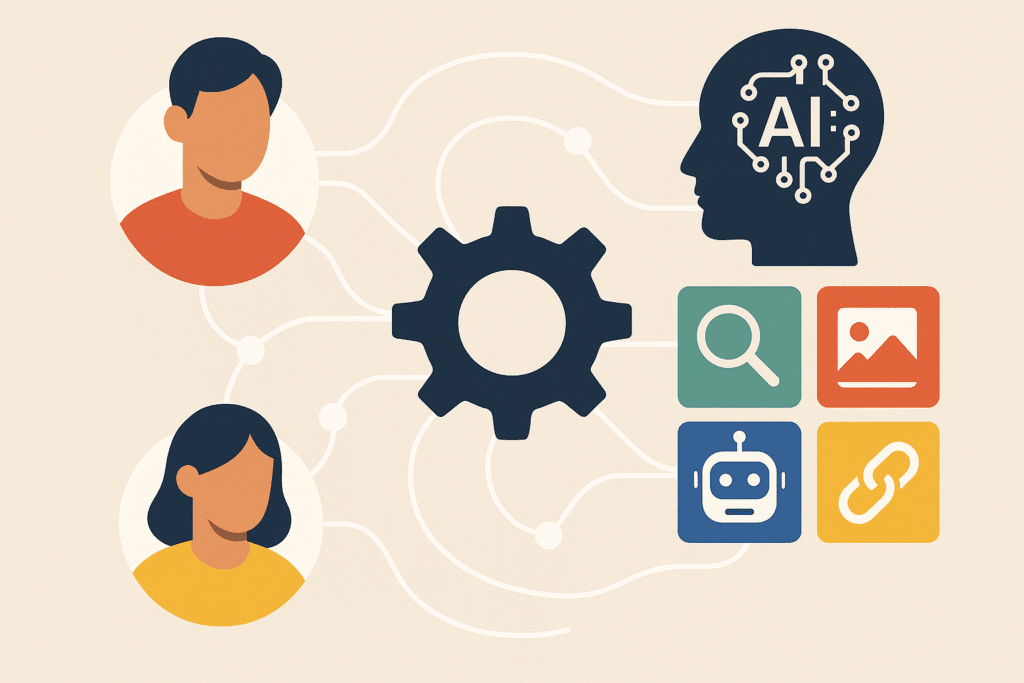
Most companies still treat AI like a stack of disconnected apps. They’ll use ChatGPT for copy, Midjourney for images, and Zapier for automations. But because nothing talks to anything else, they end up with more subscriptions and the same bottlenecks.
At Linx Digital Studio, we’ve implemented AI workflows across dozens of growth-stage companies. We’ve seen teams burn months juggling disconnected apps and others double their output by wiring together just three or four core tools.
Here’s what’s actually working in 2025.
Why Most AI Implementations Fail
Most AI rollouts don’t fail because of the technology. They fail because companies buy tools without thinking about workflow design.
Take a team that buys Jasper to fix copywriting. The tool produces good drafts, but then someone still has to paste that copy into Figma, send it to a designer, upload it into HubSpot, and then track results in Google Sheets. They added a subscription, but not a system.
The difference between “AI theater” and efficiency comes down to three rules:
Integration first. A research tool that doesn’t feed into content creation is wasted. A content tool that doesn’t plug into campaign distribution just creates copy-paste work.
Process before purchase. Teams that win with AI map their workflows first, then buy tools to improve specific steps.
Measure the flow, not the feature. You don’t need to know how many blog drafts Jasper created. You need to know if your idea-to-launch cycle is shorter and results stronger.
The Tools Actually Moving the Needle
Every tool below is either something we use internally or implement for clients. They’re organized by function and where they fit in a connected workflow.
Research That Feeds Everything Else
Replaced Google for most research. It cites sources, which is critical for strategy docs, pitch decks, or investor memos.
A browser that summarizes and organizes insights while you research. It speeds up the research-to-brief handoff.
Content That Actually Converts
Still the best AI writer for teams because of brand voice training and integrations. Works well as the middle layer between research and design.
Used for rapid creative concept testing before committing design resources.
Turn a single webinar or podcast into dozens of assets: blog posts, clips, email sequences, and social content.
Attribution That Actually Attributes
Triple Whale (for DTC brands)
The most reliable attribution for Shopify and e-commerce.
Northbeam + Rockerbox (for enterprise)
Serious tracking across multi-channel ad spend.
Customer data platforms that unify user behavior data for personalization.
Outreach That Doesn’t Feel Robotic
Automates prospect research and writes personalized intros using real data.
Cold email platforms that manage sequencing and keep deliverability intact.
Automation That Connects Everything
How Different Business Models Apply These Tools (Examples)
B2B SaaS: Research to Revenue
Perplexity → Jasper → Clay → Instantly → Segment → Retool
This flow turns research into content, connects it to personalized outreach, and closes the loop with unified analytics.
DTC / E-commerce: Creative to Conversion
Triple Whale → Midjourney → Jasper → Castmagic → Zapier
Attribution tells you what’s working, creative testing finds winners, automation scales campaigns across channels.
Agencies / Service Businesses: Delivery at Scale
Arc → Perplexity → Jasper → Retool → Clay → Instantly
Faster client research, scalable deliverables, automated dashboards, and new business outreach in one loop.
What Works (and What Doesn’t)
What’s working:
Implementing one tool at a time and connecting it properly
Training tools on brand voice and context
Using workflows where tools feed each other
Measuring system-level performance
What’s failing:
Collecting subscriptions without integration
Implementing five new tools at once
Leaving tools on default settings
Measuring feature usage instead of business impact
Who Benefits Most
Content-heavy teams publishing daily across multiple channels
B2B companies with long sales cycles and complex touchpoints
E-commerce brands needing trusted attribution and scalable creative
Agencies managing multiple clients and deliverables simultaneously
Growing teams scaling output without adding headcount
For a full categorized directory of recommended platforms, check out our AI Tools List.
Why This Matters Now
The barrier to entry for AI apps is gone. Anyone can sign up for Jasper, Midjourney, or any other tool. But the barrier to building connected systems is still high. That gap is where competitive moats are forming.
Your competitors can buy the same tools. They can’t easily replicate a connected workflow that took you three months to refine. That’s why now is the time to start.
If you want support implementing AI systems that actually compound efficiency, our team at Linx Digital Studio helps founders and marketers design AI workflows that work.