
B2B cold email is harder than it’s ever been. If you’re wondering why your response rates dropped off a cliff last year, you’re not alone. Only around 5% of cold emails succeed in getting any reply, meaning about 95% fail to spark engagement.
But here’s what most people miss: the companies still getting 15–30% response rates didn’t give up on cold email. They evolved their approach.
At Linx Digital Studio, we’ve sent over 50,000 cold emails for B2B clients in the past two years. We’ve seen what dies in inboxes and what gets executives to reply within hours. The difference comes down to understanding that B2B buyers changed faster than most outreach strategies.
Cold email still works, but the old playbook is dead. The spray-and-pray approach that worked in 2022? Inbox poison now. Generic templates with basic personalization? Spam folder material.
But there are techniques that cut through the noise. Companies using these methods are seeing response rates between 20–40%, and some of our best campaigns have hit 50%+ for specific verticals.
Here’s what we’ll cover in this article:
Why most B2B cold email fails now (and what changed)
The frameworks that actually drive responses in 2025
Advanced personalization beyond “I saw your LinkedIn post”
Tools and workflows that scale without losing effectiveness
Real campaign examples with specific results
How to build a system that improves over time
Why B2B Cold Email Got So Much Harder
Before jumping into tactics, you need to understand what shifted. B2B decision makers didn’t just get busier, they got smarter about filtering out noise.
Three things changed the game:
1. Email filters got aggressive. Gmail and Outlook now flag emails based on domain reputation, content patterns, and engagement history. If too many of your emails go unopened or ignored, your sender reputation tanks.
2. Buyers became pattern-aware. Prospects have seen every “I noticed your company does X” template. They delete these instantly. Generic outreach is a delete trigger now.
3. Inboxes became battlefields. The average B2B executive gets 120+ emails daily. Your message doesn’t just compete with other sales emails, it’s fighting internal comms, vendor updates, and actual business priorities.
This doesn’t mean cold email is dead. It means lazy cold email is dead.
The B2B Cold Email Frameworks That Actually Work
Most cold email advice focuses on templates. That’s backwards. Templates are execution. Frameworks are strategy.
Here are the proven frameworks that drive responses across thousands of emails:
1. The Research Insight Framework
Works when you surface insights the prospect doesn’t know about their own company or market.
Structure:
Hook: unique insight about their business or competitors
Context: how you found this insight
Value: why it matters to them
Ask: soft question about their approach
Why it works: Leads with value, not a pitch. Shows real research.
2. The Peer Reference Framework
Uses social proof from similar companies without oversharing.
Structure:
Hook: similar company result
Context: why they’re in the same situation
Value: specific improvement achieved
Ask: interest in similar outcomes
Why it works: Creates curiosity and credibility without “name dropping.”
3. The Process Improvement Framework
Addresses operational inefficiencies that create measurable pain.
Structure:
Hook: process inefficiency you observed
Context: its impact on their business
Value: case study of improvement
Ask: how they’re handling it today
Why it works: Focuses on tangible business problems, not abstract features.
4. The Contrarian Insight Framework
Challenges conventional wisdom with data.
Structure:
Hook: bold, contrarian statement
Context: why the common approach fails
Value: alternative that works better
Ask: have they seen the same issue
Why it works: Positions you as someone with a fresh perspective, backed by data.
5. The PAS Framework (Problem–Agitate–Solve)
The classic structure that works when the pain point is clear.
Structure:
Problem: identify the issue
Agitate: highlight consequences of inaction
Solve: proof-backed solution
Ask: small next step
Why it works: Follows the natural thought flow from problem to solution.
6. The AIDA Value Framework
Perfect when they’re not actively looking but could benefit.
Structure:
Attention: hook with an observation
Interest: tie it to their business
Desire: show results from others
Action: ask one clear CTA
Why it works: Creates curiosity and desire before asking for commitment.
7. The Observation Hook Framework
Best when you can tie outreach to something specific and recent.
Structure:
Observation: recent change in their company
Impact: why it matters
Solution: example of how you solved this elsewhere
Ask: short question to start conversation
Why it works: Shows you’re paying attention, not blasting templates.
Advanced Personalization That Actually Matters
To stand out, you need context-driven personalization that connects your solution to their reality.
Business context: tie to funding rounds, hiring changes, or new launches.
Competitive intelligence: show how they stack up against peers or threats.
Stakeholder networks: reference who they follow or interact with.
Why it works: Moves beyond “I saw your LinkedIn post” into strategic relevance.
Real-World Example - Aaron Reeves
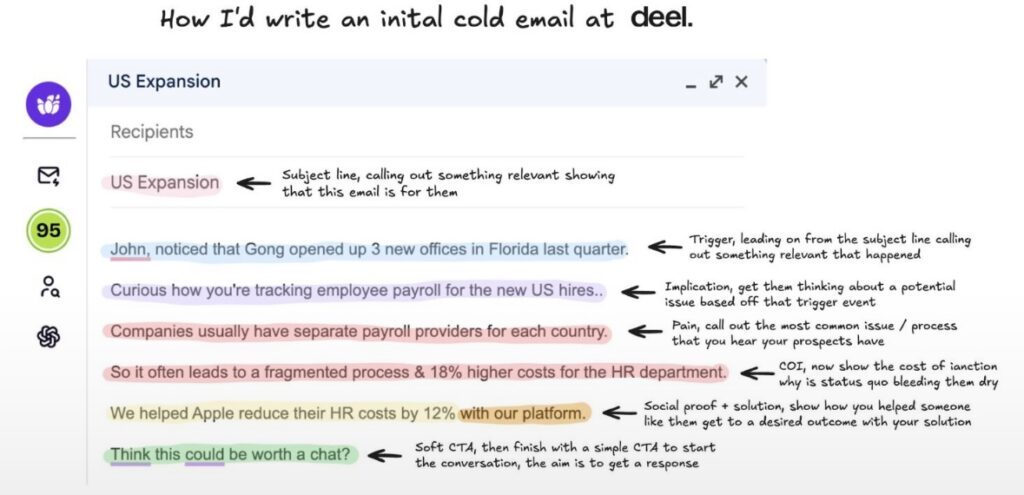
Outbound consultant Aaron Reeves, CEO at Outbound OS, shared a breakdown of how he would structure a cold email if he were a rep at Deel, one of the biggest HR providers in the world.
His approach shows how elite sales teams structure short, relevant, and high-performing emails using the Trigger → Cost of Inaction (COI) → CTA method.
Framework:
Trigger – Start with a relevant event or update in the prospect’s world.
Cost of Inaction (COI) – Show what they risk losing if they don’t act.
CTA – Keep it frictionless with a simple ask to start the conversation.
Why this works:
Starts with personalization tied to Gong’s expansion.
Highlights a real problem (fragmented payroll and higher costs).
Frames the cost of inaction clearly (18% higher HR costs).
Uses social proof by referencing Apple.
Ends with a soft CTA that’s easy to say yes to.
Aaron’s example is a perfect demonstration of cold email in 2025: concise, relevant, focused on the prospect’s pain, and built around credibility rather than hype.
The 7 Principles That Separate Winners From Spam
From analyzing over 50,000 emails, these are the non-negotiables:
Spend 80% of your time on list building.
Give value before asking.
Write for one person, then scale.
Fix deliverability first.
Go the extra mile on research.
Integrate with other channels.
Use tech to scale personalization, not volume.
Wrapping Up
Personalized cold emails sent to the right audience can still drive strong results. The best ones do not try to sell immediately. Instead, they spark conversations and provide value that feels relevant and timely.
The fundamentals remain simple: respect regulations like CAN-SPAM and GDPR, focus on prospects that fit your ideal customer profile, use outreach tools to manage automation without losing authenticity, and constantly test subject lines, opening hooks, and calls to action. Measure results and keep refining until you find what works best.
Cold email is not about volume. It is about clarity, timing, and insight. If your message helps your prospect understand something new or solve a real problem, you will stand out in their crowded inbox.
Ready to implement a cold email system that consistently drives pipeline? Get in touch with us and let’s build an outreach engine that delivers results.